At a glance
- The former champion track cyclist and racing driver Sir Chris Hoy on why driving a Porsche has become a welcome escape from everyday life.
- From a classic 964-generation Carrera 2 to a 992-generation GT3 RS, Hoy reflects on what makes the Porsche 911 so rewarding to drive.
- His diagnosis with stage four prostate cancer has inspired him to raise awareness and encourage men to understand their individual risk.
- Hoy's message is one of optimism: enjoy today, because life is lived one corner at a time.
There are moments on a racetrack when the world narrows to a single task. Full power up to the braking point. Hard on the brakes. Turn in. Find the apex. Feed in the throttle. Let the car breathe on the exit. Then do it all again – with no room for anything else.
For Sir Chris Hoy, whose diagnosis with stage four prostate cancer became public in 2024, those moments have become far more than the pursuit of a perfect lap. “When you're flying round a track and you're focusing on the next braking point and the next apex, balancing the car and all the things you need to be really in the moment with, there's no space to think about cancer,” the 50-year-old says. “I found it was the only way I could take my mind off it.”
Two generations of 911
The six-time Olympic gold medallist’s Porsche garage spans more than three decades of 911 development. Parked alongside a Guards Red 1990 964 Carrera 2, his everyday road car, is a 992 GT3 RS, delivered following an unexpected encounter at the Nürburgring.
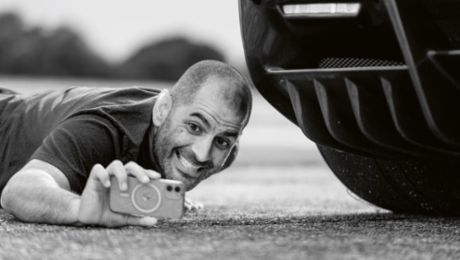
Hoy had travelled to Germany with every intention of keeping his previous GT3 RS. Then automotive journalist and TV presenter Chris Harris invited him to drive a 992 GT3 RS press car borrowed from Porsche Cars Great Britain.
“It was just astonishing,” he grins. “I couldn't believe how the game had moved on. But that's what Porsche does: every time you think, ‘this has to be the ultimate’, they somehow find another way to push it further.”
Since then, Hoy has covered about 8,000 kilometres in his new GT3 RS, much of it travelling to circuits across Europe.
“I drove it to Zandvoort for a couple of track days and then drove home afterwards,” he says. “It's astonishing what it can do on the track, but also how comfortable it is to drive there. It feels like a GT race car on the circuit but a road-trip car everywhere else.”
Meanwhile, his 964 provides an entirely different experience. “It's the perfect road car for me,” says the father of two. “You step back into an older car and realise how much space there is on the road. The fun you have is at a lower speed, but you're so involved in everything the car is doing.”
Whether he's driving the 964 on a road trip or chasing lap times at Spa-Francorchamps, Hoy is searching for the same thing. “When it comes to the pure purpose of driving a car for that exhilaration, that fun and that feeling of connection, that's what the 911 does for me.”
The parallels with elite sport are hard to ignore. “It's always about finding a way to go faster or squeeze a little bit more performance out,” he says. “That's what I loved in cycling and it's what I still enjoy on track.”
A message that could save lives
Today, however, progress means something different, too. Hoy is using his global profile to raise awareness of prostate cancer, encouraging men to understand their own individual risk and seek advice early. “In the first instance, it feels totally hopeless,” he says of receiving his own diagnosis. “But then it becomes about trying to find something positive from the situation.”
Through charity rides – including the now annual Tour de 4 event in Scotland, which members of the public are invited to join on 6 September 2026 – as well as fundraising events and track days, Hoy has helped raise millions for cancer charities while encouraging men around the world to have conversations that could ultimately save lives.
“The message that I'm banging the drum about is for men to understand their own individual risk. Just go online, search ‘prostate cancer risk’, look into it and, if you think you’re at high risk, go and see your doctor. Ask for a PSA [prostate-specific antigen] test,” he says. The responses he has received have reinforced that mission. “People have told me they've gone for a test because of my diagnosis and they've caught it early. That's a very powerful thing.”
Asked what keeps him optimistic, Hoy pauses. “The key thing is not allowing it to spoil the time that I've got,” he says. “None of us are going to live forever. It's just a timely reminder that we've got to enjoy and appreciate what we're doing right now. This is life, today. It's not about tomorrow or next week or next year. It's about today.”
Info
Bilder: Richard Pardon
Copyright: All images, videos and audio files published in this article are subject to copyright. Reproduction in whole or in part is not permitted without the written consent of Dr. Ing. h.c. F. Porsche AG. Please contact newsroom@porsche.de for further information.